Gaza Residents Rush to Stockpile Food as Iran War Triggers Crossing Closures
By Newslab Admin
Updated
24 views
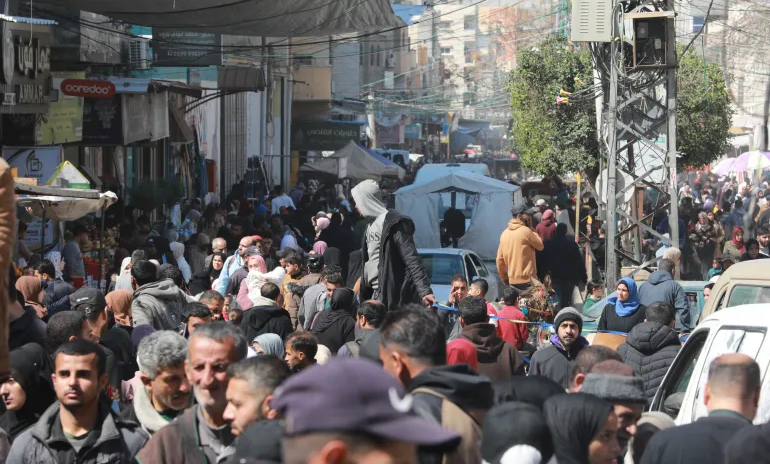
Panic buying swept markets across Gaza after news of escalating conflict between Israel and Iran and the sudden closure of border crossings sparked fears of renewed shortages in the already fragile enclave.
What began as an ordinary Ramadan shopping trip quickly turned into anxiety for 51-year-old Hani Abu Issa when he arrived at Deir el-Balah market on Saturday morning intending only to buy ingredients for his family’s iftar meal.
Instead, he found crowds rushing grocery stores, shelves rapidly emptying and shoppers carrying sacks of flour as rumours of war spread.
“A passer-by told me Israel had struck Iran and war had broken out,” Abu Issa said. “People immediately began buying everything they could.”
Within hours, markets across Gaza were overwhelmed as residents stocked up on flour, sugar, cooking oil and yeast, driving up prices of essential goods.
Fear shaped by past famine
Although the fighting is not taking place inside Gaza, residents say previous experiences of hunger and shortages have left deep psychological scars.
“People have become afraid of everything,” Abu Issa said. “Everyone rushed to the markets, and that caused shortages and rising prices.”
Anxiety intensified after Israel’s Coordination of Government Activities in the Territories (COGAT) announced the closure of crossings into Gaza and the occupied West Bank “until further notice,” citing security developments linked to the Iran conflict.
For many Palestinians, the announcement revived memories of last year’s Ramadan, when prolonged closures severely restricted aid and commercial supplies, contributing to widespread hunger and soaring food prices.
“The worst days were when a sack of flour cost more than 1,000 shekels,” Abu Issa recalled. “I don’t want to live through that again.”
He said stockpiling offers little comfort given Gaza’s living conditions.
“Goods run out quickly, and we don’t even have proper conditions to store them. All we need is reassurance that the crossings will reopen.”
Markets gripped by uncertainty
Local reports suggested the closures may also be linked to the Jewish holiday of Purim, but residents said uncertainty over how long restrictions would last added to public fear.
In Nuseirat market, grocery seller Omar Al-Ghazali said memories of famine were driving current behaviour.
“People’s fear is justified,” the 28-year-old father of four said. “Even though the war is not happening here, the fear of hunger is stronger than logic.”
He added that traders were struggling to calm customers as demand surged.
“We cannot tell people not to buy. What they went through was extremely difficult.”
Many unable to stockpile
Not all families have the means to prepare for potential shortages.
Asmaa Abu Al-Khair, a 38-year-old mother of eight, walked through Gaza City’s market empty-handed, unable to afford extra supplies.
“Where would we store anything? And what could we even buy?” she said. “We can barely provide daily food during Ramadan.”
She said displaced families living in tents faced even greater hardship, lacking both money and storage space.
“I’m afraid famine will return. I have young children,” she said. “Why close the crossings now? What do we have to do with this war?”
The announcement left her feeling devastated, she added. “It felt like a stab in my heart.”
Exhaustion and resignation
Others expressed resignation rather than panic.
Mohammed Daher, 46, displaced from Jabalia and now living in Deir el-Balah, said he decided not to stockpile despite rising fears.
“For the first time in two years, Ramadan felt calm,” he said. “Then the news of war came, and I felt lost again.”
Having spent most of his savings during previous shortages, he said he no longer had the energy to endure another crisis.
“Everything was priced like gold,” he said. “Now I just accept whatever happens.”
Humanitarian concerns deepen
The crossing closures triggered widespread criticism online, with many Palestinians accusing Israel of worsening Gaza’s humanitarian situation while global attention shifts toward regional conflict.
Ali al-Hayek, a member of the Palestinian Businessmen Association in Gaza, warned that prolonged closures could halt aid distribution, disrupt charitable kitchens and block urgent medical travel for patients requiring treatment abroad.
He said Gaza’s economy has already contracted sharply after years of war, with unemployment nearing 80 percent and most industrial facilities no longer operating.
Al-Hayek urged international intervention to reopen crossings and ensure the flow of goods and people, while also calling on traders to avoid price increases during Ramadan.
“This is a time for solidarity,” he said.
Anxiety amid a widening regional war
As tensions between Iran, Israel and the United States escalate, Gaza residents fear they may once again bear indirect consequences of a conflict unfolding beyond their borders.
For many, the rush to stockpile is less about current shortages and more about trauma from past deprivation — a reminder that even distant wars can quickly reshape daily life in one of the world’s most vulnerable territories.