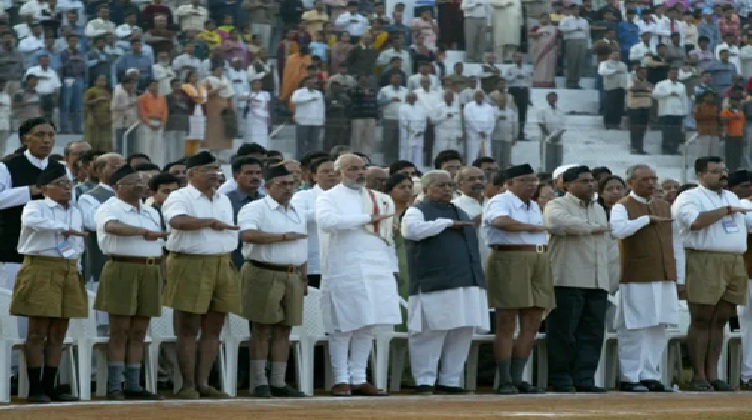
Why India’s RSS Is Lobbying the West Amid Attacks on Minorities at Home
By Newslab Admin
Updated
14 views
India’s influential Hindu nationalist organisation, the Rashtriya Swayamsevak Sangh (RSS), has intensified outreach efforts in the United States and Europe amid growing international concern over rising attacks and hate speech targeting religious minorities in India.
The move comes months after a report by the United States Commission on International Religious Freedom (USCIRF) accused the RSS of involvement in violence and intolerance against minority communities over several decades.
What Is the RSS?
Founded in 1925 in Nagpur by Hindu nationalist Keshav Baliram Hedgewar, the RSS is the ideological backbone of India’s Hindu far-right movement. The organisation promotes the concept of Hindutva — a Hindu nationalist ideology seeking to reshape India from a secular republic into a Hindu-majority state.
The RSS operates a vast network of schools, charities, publishing houses and social organisations under a broader umbrella known as the Sangh Parivar.
Critics and historians have long accused the RSS of drawing inspiration from European fascist movements. Scholars point to early RSS leaders’ admiration for Italian dictator Benito Mussolini and references to Nazi Germany in writings by former RSS chief MS Golwalkar.
The organisation has also faced multiple bans in India, including after the assassination of independence leader Mahatma Gandhi in 1948 by a former RSS member.
Links With India’s Ruling BJP
The RSS is widely regarded as the ideological parent of India’s ruling Bharatiya Janata Party (BJP).
Prime Minister Narendra Modi has been associated with the RSS since 1972 and later joined the BJP in 1987. Under Modi’s leadership, the BJP secured historic electoral victories in 2014, 2019 and 2024.
Critics argue that the growing political influence of the RSS has coincided with increasing hostility toward Muslims and Christians in India.
Rising Concerns Over Hate Speech and Violence
According to the US-based research group India Hate Lab, incidents of hate speech against minorities rose by 13 percent in 2025, with many cases occurring in BJP-governed states.
The report also documented a sharp rise in anti-Christian hate speech, alongside continued attacks on Muslims, including mob lynchings and targeted violence linked to allegations surrounding cattle slaughter and beef consumption.
Human rights organisations and analysts have blamed the political climate fostered by the BJP and RSS for escalating communal tensions — allegations both groups deny.
Raqib Hameed Naik, executive director of the Center for the Study of Organized Hate, said there has been a “disturbing escalation” in hate crimes, discriminatory laws and actions targeting minority communities.
RSS Outreach to the West
RSS General Secretary Dattatreya Hosabale recently travelled to the United Kingdom, United States and Germany in an effort to counter what the organisation describes as “misconceptions” about the RSS.
During his visits, Hosabale met academics, policymakers, think tanks and members of the Indian diaspora. In London, he reportedly interacted with institutions including Chatham House, while in Washington he held discussions with the conservative Hudson Institute.
Hosabale rejected allegations that the RSS promotes Hindu supremacy or treats minorities as second-class citizens, insisting that the accusations are inaccurate.
Why the International Campaign Matters
Experts believe the RSS outreach campaign is aimed at preventing possible international sanctions and protecting its global image.
The USCIRF report recommended targeted sanctions against RSS leaders over alleged persecution of minorities — a recommendation analysts say has alarmed the organisation.
Observers also note the growing influence and financial strength of the Indian diaspora in Western countries, some of whom actively support RSS-linked initiatives abroad.
Analyst Apoorvanand of the University of Delhi said the RSS seeks to build a worldwide network of right-wing conservative groups and strengthen its ideological influence internationally.
Meanwhile, critics argue the international visits amount to “damage control” as scrutiny over minority rights in India intensifies. [Source: Al Jazeera]